Most small dairy farms in Pakistan do not lose money on milk price alone. They lose it quietly, in breeding: missed heats, late heifers, failed inseminations and long gaps between calvings. This guide brings together Pakistani and international research into one practical plan a farmer can follow, from catching heat to a healthy calving.
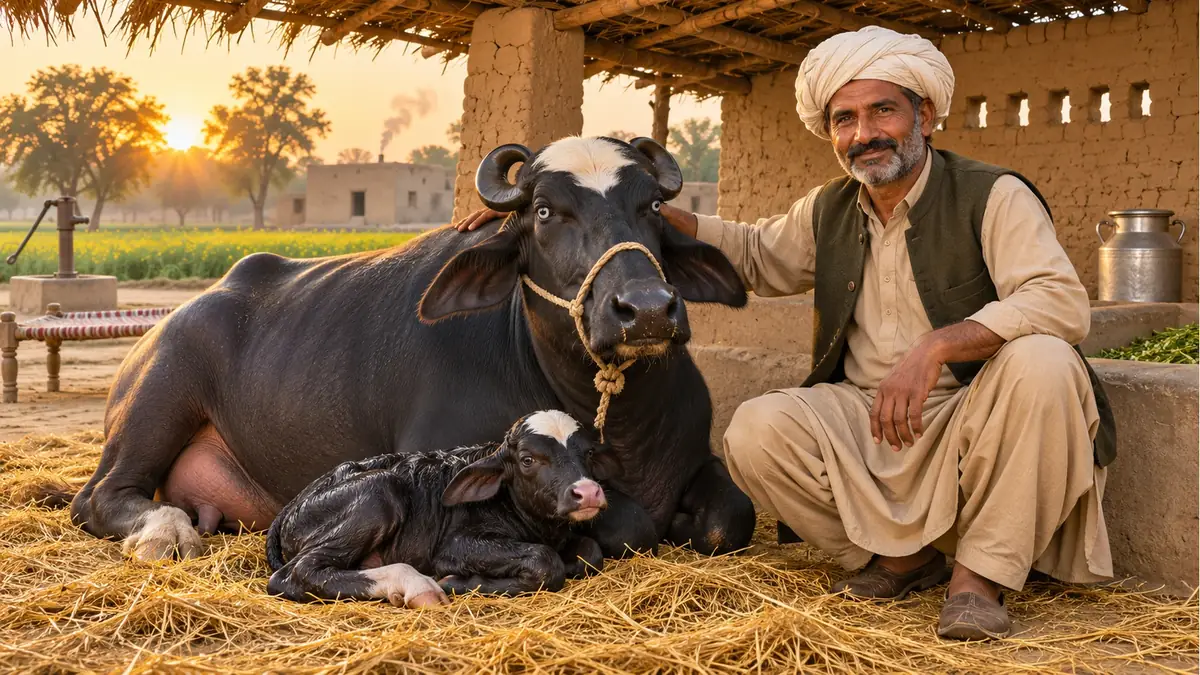
Every figure below comes from published studies, mostly on Nili-Ravi buffaloes and Pakistani cattle. Where a step needs medicine or an internal check, it is marked for your vet/doctor.
The real cost: every month a buffalo stays empty
A Nili-Ravi buffalo calving every 13 months gives about 2 more calvings in 10 years than one calving every 17 months. That is roughly 3,700 litres of milk and 2 calves lost.
The Pakistani average is close to the slow side. A study of 9,300 Nili-Ravi buffaloes found an average calving interval of 501 days, and a government farm study found 528 days. Average milk per lactation is about 1,830 litres.
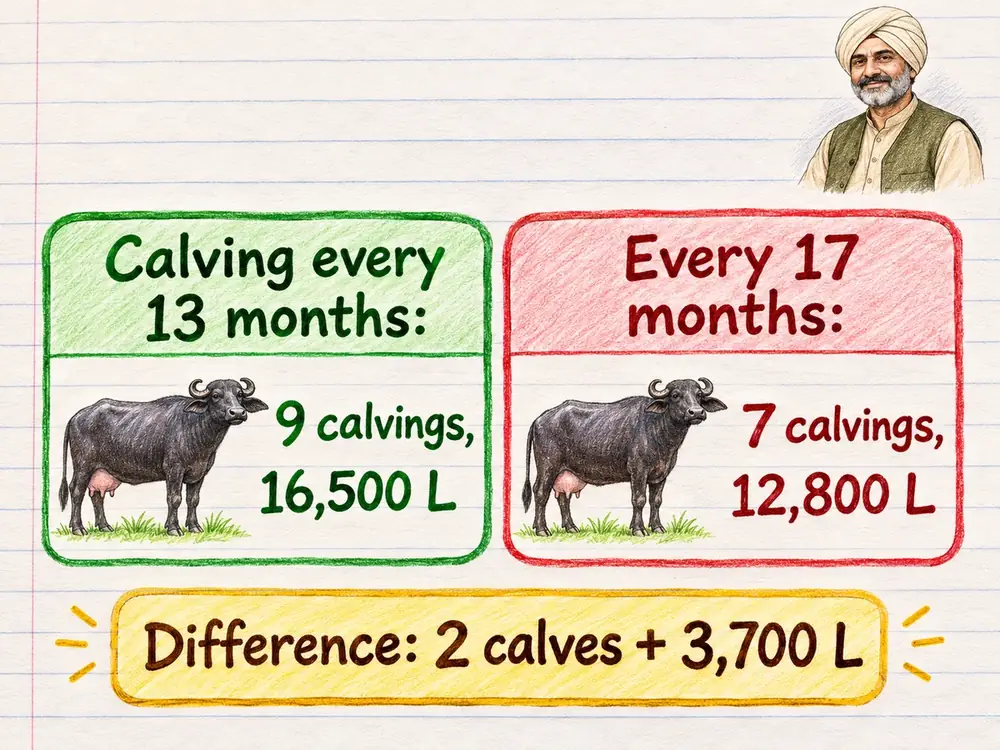
| Over 10 years | Calving every 13 months | Calving every 17 months |
|---|---|---|
| Calvings | 9 | 7 |
| Milk (litres, approx.) | 16,500 | 12,800 |
| Difference | 2 calves + 3,700 litres |
At 180 rupees a litre, that gap is about 6.6 lakh rupees per buffalo. The target is simple: get the buffalo pregnant again within about 90 days of calving (gestation is about 308 days, so 13 months between calvings).
Step 1: Catch the heat you are missing
Most "no heat" buffaloes are actually in heat; the farmer just does not see it. In Pakistani buffaloes with no observed heat, 73% had silent heat, and only about 9% were truly not cycling. About half of all buffalo heats are silent.
One missed heat costs a full 21-day cycle of feed with no progress towards a calf.
When to watch
- Buffalo: signs peak in the early morning and late evening, least at noon. Most heats come in winter (about 42% in Nili-Ravi) and fewest in summer (about 26%).
- Cow: about 70% of standing heat happens between 6 pm and 6 am. The only sure sign is a cow standing still when others mount her.
- How often: watching twice a day for 30 minutes catches 75–80% of heats; three times a day about 85%; four times over 90%.
The most reliable buffalo sign: clear, glass-like mucus from the vulva, seen while the buffalo is lying down. A teaser bull nearby also helps find silent heats.
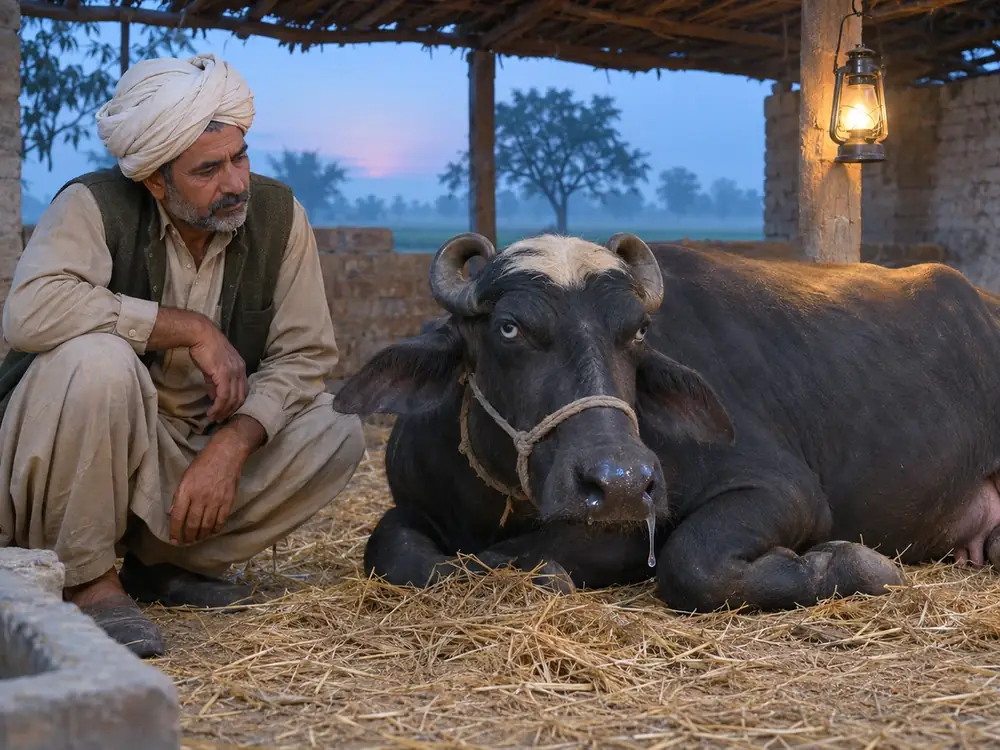
Keep a written record of every heat and service date for each animal.
Step 2: Inseminate at the right time, not the first moment
Calling the AI technician the moment heat is seen is one of the most common mistakes. In a UVAS study of 109 Nili-Ravi buffaloes, pregnancy depended heavily on when AI was done after the start of standing heat:
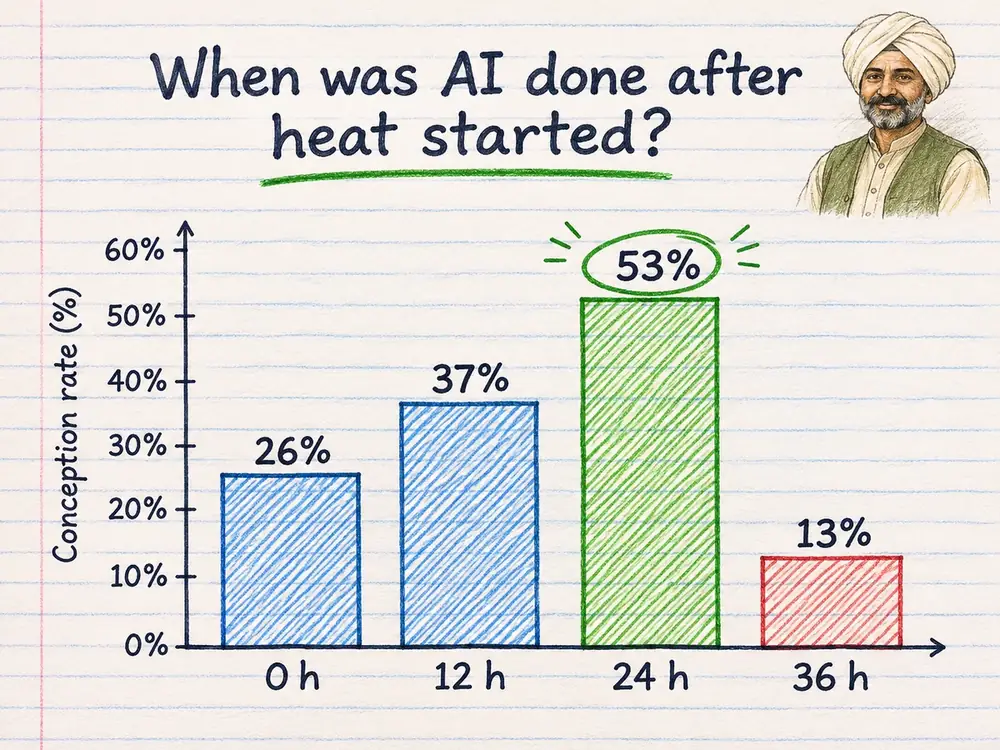
| AI after heat started | Became pregnant |
|---|---|
| Immediately (0 h) | 26% |
| 12 hours | 37% |
| 24 hours | 53% |
| 36 hours | 13% |
A Punjab field study agrees: AI 12–24 hours after heat signs gave 29% conception against 19% at 24–48 hours.
Rule: not immediately, and never later than about 36 hours. Aim for 12–24 hours after heat starts, which is why knowing when it started (Step 1) matters.
Who and how also matter. In the same Punjab study, AI by a degree-holding vet/doctor gave 34% conception against 20% by diploma holders, and correctly handled semen gave 35% against 16% for poor semen. Ask how the semen is thawed and use a trained inseminator.
In summer, cool the buffalo (shade, sprinklers) for about 3 hours before and after AI; heat stress lowers conception and raises embryo loss.
Step 3: After AI, count the days
The day a buffalo comes back into heat tells you what went wrong. Most early pregnancy losses happen in the first weeks, and the timing separates a failed AI from a lost embryo.
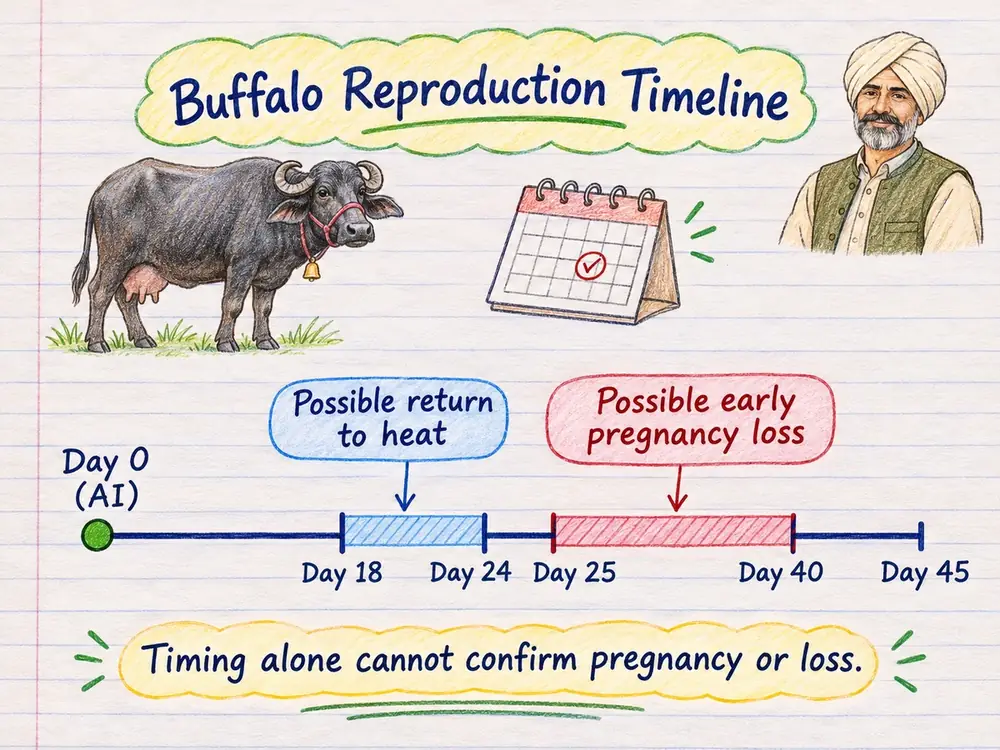
| Back in heat after AI | What it usually means | What to do |
|---|---|---|
| 18–24 days | AI did not take | Check AI timing, semen handling and uterus; inseminate correctly at the next heat |
| 25–40 days | She was probably pregnant, but the embryo died | Not the semen's fault: look at heat stress, transport, sudden feed change, infection, minerals |
| No heat at all | Not proof of pregnancy (silent heat is common) | Pregnancy check by vet/doctor |
Protect the first month after AI: no transport, no sudden change in feed, protection from summer heat, and a steady mineral mixture.
Confirm pregnancy: ultrasound from about day 30, or rectal check by a vet/doctor at about 45–60 days.
Step 4: No heat? Check these 6 things before buying any heat powder
No powder or kit can fix a thin animal or a ration without minerals. A buffalo normally returns to heat 30–90 days after calving; before that, do not worry.
- Days since calving. Under about 60–90 days is often normal.
- Pregnancy first. If a bull or AI was used, check pregnancy before any heat medicine.
- Body condition. Ribs and hip bones clearly visible means too thin. Animals with a body condition score below 2 had their first heat delayed beyond 60 days; buffaloes at 3.5–4 came in heat around day 61. Being too fat at calving is also harmful.
- Licking walls, eating soil or bones (pica). A classic sign of phosphorus shortage, which also stops heat. Most farmers give only salt. In a Punjab trial, 50 g a day of area-specific mineral mixture for 2 months brought 85% of non-cycling buffaloes back into heat.
- History after calving. Retained placenta or smelly white-yellow discharge points to uterine infection: see the vet/doctor.
- Silent heat check. Look at dawn for clear mucus while she lies down (Step 1). Also deworm, including for liver fluke if fodder comes from canal banks.
Still no heat after about 90 days? Get a diagnosis, then the right protocol. A protocol without a rectal check or ultrasound is a guess. Ultrasound is much more accurate than hand palpation for ovarian cysts (about 85% vs 51% correct).
| What the vet/doctor finds | Evidence-based treatment (vet/doctor only) |
|---|---|
| Silent heat (active ovary with a corpus luteum) | Prostaglandin, effective in about 80% of selected cases |
| Pus in the uterus (pyometra) | Prostaglandin, then a follow-up check |
| Inactive ovaries (true anestrus) | Feed and minerals first, then a CIDR-based programme (55% pregnancy vs 23% for a single GnRH shot in one trial) |
| Ovarian cyst | GnRH-based or prostaglandin, depending on cyst type |
| Regular heat but repeated failure | GnRH at the time of AI (+22.5% conception in a 40-study analysis) |
| No reproductive tract or no response | No treatment works: fatten or sell |
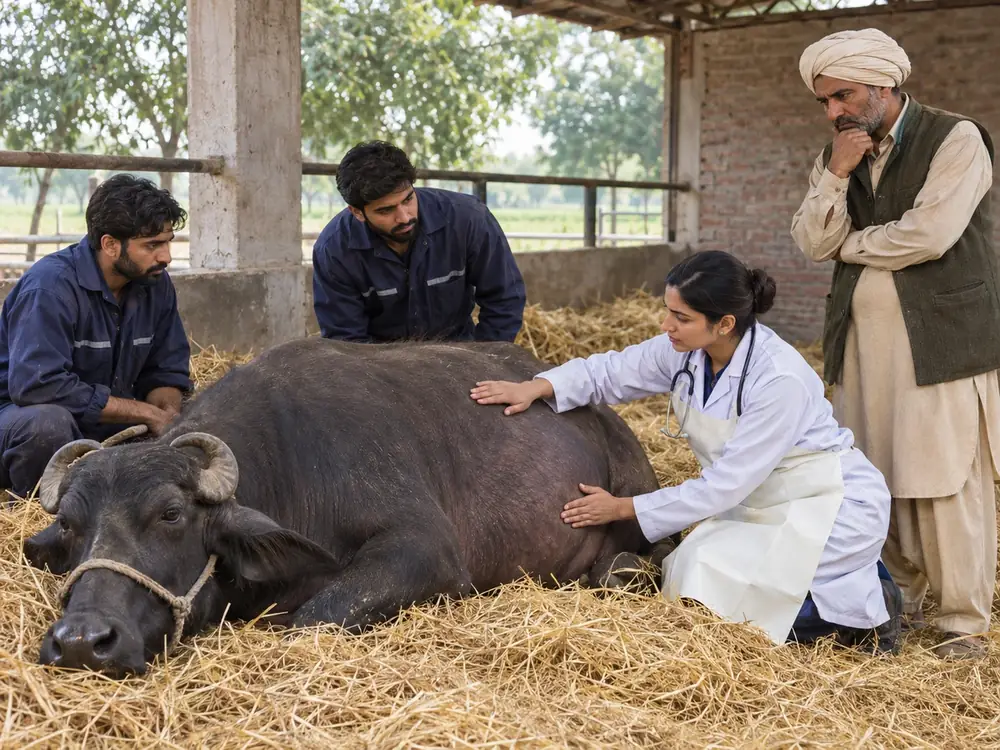
In summer, simple Ovsynch failed in non-cycling Nili-Ravi buffaloes (0%), while CIDR-based programmes gave 30–37%. Uterine antibiotic boluses after AI did not improve conception in a 335-cow trial.
Step 5: Raise heifers that calve at 3 years, not 4.5
The average Nili-Ravi heifer in Pakistan has her first calf at about 1,685 days, roughly four and a half years old. Until then she only costs money.
The main cause is feeding, not breed. Heifers come into heat by weight (around 300 kg), not by age, and under normal rearing they weigh only about 240 kg at 2 years.
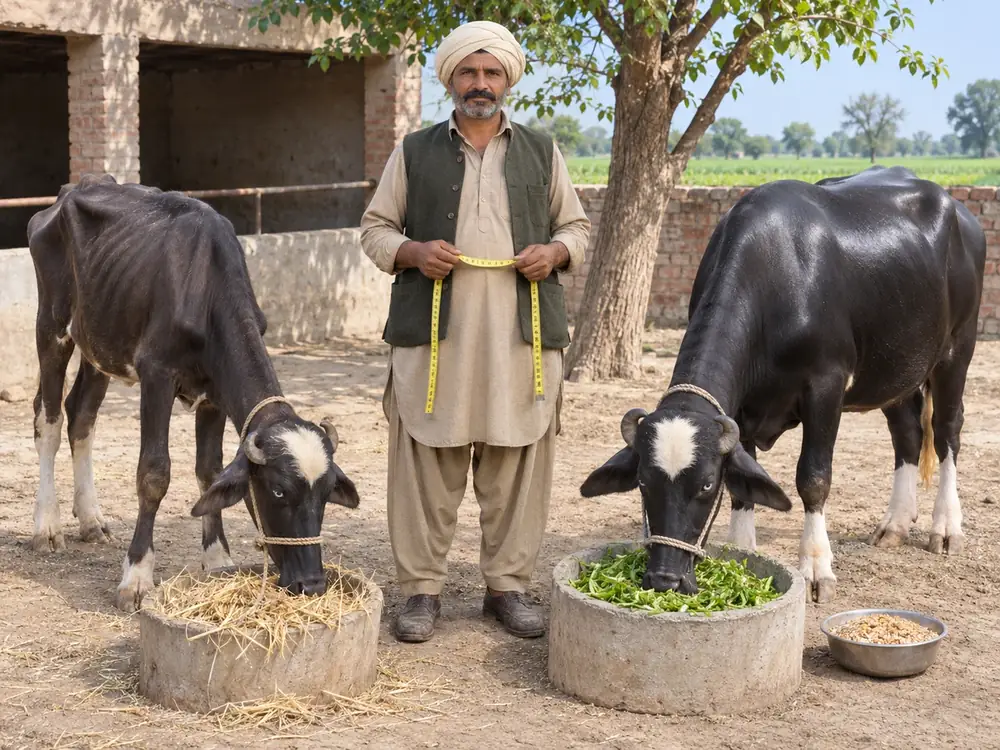
| Heifer feeding (from about 12 months) | Age at puberty |
|---|---|
| Forage only | 35.8 months |
| Forage + 1 kg concentrate a day, then 1.5 kg | 23 months |
One kilogram of concentrate a day brought puberty a full year earlier. A Pakistani review concludes buffalo heifers can reach maturity at about 2 years with better feeding and management.
- First year: colostrum within the first hours, deworming on time, and enough milk.
- After 6 months: green fodder, a little concentrate (about 0.5% of body weight) and mineral mixture daily.
- Every 3 months: check weight or chest girth, so you know she is growing, not just ageing.
Step 6: Protect the calving that all this work leads to
Uterine torsion is the buffalo's biggest calving problem. At veterinary centres, a twisted uterus causes about 52–83% of difficult buffalo calvings. The deep belly, wallowing, slipping, fights and transport in late pregnancy all raise the risk.
- Signs: a full-term buffalo is restless, kicks at her belly, stops eating and ruminating, strains but no water bag or feet appear, and one lip of the vulva looks pulled to one side.
- Do not pull or inject at home. A twisted uterus cannot deliver by pulling and can tear. Call the vet/doctor at once; rolling the buffalo corrects about 9 in 10 cases when done in time.
- Prevention: keep pregnant buffaloes separate in the last 2 months, on a level, non-slippery floor, away from fights and transport.
Retained placenta (jeer): do not pull it. Normal expulsion takes 3–8 hours; it counts as retained after 24 hours. Leading veterinary guidance says manual removal is not recommended and is potentially harmful, and untreated cows expel it in 2–11 days.
- Tie the hanging part so it does not touch the hocks, keep dogs away, and call the vet/doctor if she has fever or stops eating.
- Oxytocin, calcium drenches and uterine boluses have not been shown to speed expulsion.
- Vitamin E and selenium help prevent it where they are deficient.
Before calving: buffaloes with pre-calving prolapse had lower calcium and phosphorus in Punjab studies. Keep the mineral mixture going in late pregnancy.
Hidden causes most farmers never suspect
- Twin heifer born with a bull calf (freemartin). About 92% of such heifers are sterile, because the bull twin's hormones stop her reproductive tract from developing. This is mainly a cow problem: Holstein cows have twins in about 3.8% of calvings, Nili-Ravi buffaloes in only about 0.3%. A vet/doctor can check her in the first 1–4 weeks: a normal calf's vagina is 13–15 cm long, a freemartin's only 5–6 cm. If she is a freemartin, fatten or sell her rather than raising her for 3 years.
- Too much cottonseed cake (khal binola). In a Faisalabad study on Nili-Ravi buffaloes, heat and ovulation were normal but conception was 50% against 83% in the control group (a small study). Gossypol in the cake can harm the early embryo. Keep it to a moderate share of the ration for breeding animals, heifers and bulls.
- Mouldy feed. Mould on maize, wheat or other grain can produce zearalenone, which acts like oestrogen: constant or repeated heat, swollen vulva, discharge, cysts and embryo loss. Problems usually ease 2–3 weeks after the feed is removed.
- The shared village bull. Venereal infections (Trichomonas, Campylobacter) spread silently through natural mating and cause repeat breeding. A healthy, tested bull is fine; an untested bull covering many herds is the risk.
- Liver fluke from canal-bank fodder. Damages the liver and fertility. Ordinary dewormers often do not kill it, and resistance to some flukicides has been reported in Pakistan, so ask your vet/doctor for a dung test and the right drug.
- Brucellosis. Causes late abortion and retained placenta, and infects people. Handle an aborted calf and placenta only with gloves, bury or burn them, isolate the animal, and test new animals before buying.
Write down every heat, AI and pregnancy check in the breeding and health record sheet. Track heifer growth by chest girth with the cow and buffalo weight calculator, and price heifer concentrate with the feed cost calculator.
Farmer's breeding checklist
- Watch for heat at least twice a day, at dawn and in the evening (cows also at night)
- Write down every calving, heat and AI date
- AI 12–24 hours after heat starts, by a trained inseminator
- Count the days if she returns to heat after AI
- Pregnancy check at 30–60 days
- Mineral mixture daily, not just salt
- Keep body condition around 3 (ribs not visible, hips not sharp)
- Deworm calves and heifers on schedule; check for liver fluke
- Concentrate for heifers from about 12 months
- No transport or fights for pregnant animals; cool animals in summer
- No pulling of a stuck calf or retained placenta; call the vet/doctor
- No heat 90 days after calving: diagnosis first, then the right protocol
Frequently asked questions
My buffalo calved 15 days ago and was mated. Can she be pregnant?
Unlikely. The uterus needs about 30–45 days to recover, and early "heat" is often just discharge. Breed at a heat after 45–60 days.
Do heat powders work?
Not for a thin animal or one short of minerals, which is the most common cause. Fix feed and minerals, check for silent heat, and get a diagnosis.
Is natural service better than AI?
A healthy, tested bull can give good results. The risk is an untested bull shared by many herds, which can spread infections that cause repeat breeding.
Why does my buffalo come back into heat after 35 days?
She was probably pregnant and lost the embryo. Look at heat stress, transport, feed changes, infection and minerals.
This article is general guidance based on published research. Medicines and internal examinations should always be handled by a qualified vet/doctor. Images are AI-generated illustrations.
Sources
- Nili-Ravi reproductive traits, 9,300 records
- Reproductive performance of Nili-Ravi buffaloes, government farm
- Milk yield per lactation, Pakistan Veterinary Journal 2007
- AI timing in Nili-Ravi buffaloes, Animal Reproduction 2017
- Concentrate supplementation and age at puberty in buffalo heifers
- Growth traits of Nili-Ravi heifers
- Reducing age at first calving, review
- Retained fetal membranes in cows, MSD Veterinary Manual
- Freemartinism in cattle and buffalo
- Treatment of postpartum anoestrus
- GnRH in repeat breeders
- CIDR vs single GnRH in true anestrus
- Ovsynch vs CIDR in Nili-Ravi buffaloes, Pakistan Veterinary Journal 2015
- Intrauterine antibiotic after AI in repeat breeders
- Cystic ovarian disorders, Penn State Extension
- Fluke drug resistance in Khyber Pakhtunkhwa
Published 2026-11-18.